
In high-performance optical and laser systems, the smallest details often have the greatest impact. Fiber end caps are a perfect example of this principle.
These precision-engineered glass components protect, optimize, and extend the performance of optical fibers in some of the most demanding applications on earth, from high-power fiber lasers to photonic sensing systems and advanced telecommunications.
What is a Fiber End Cap?
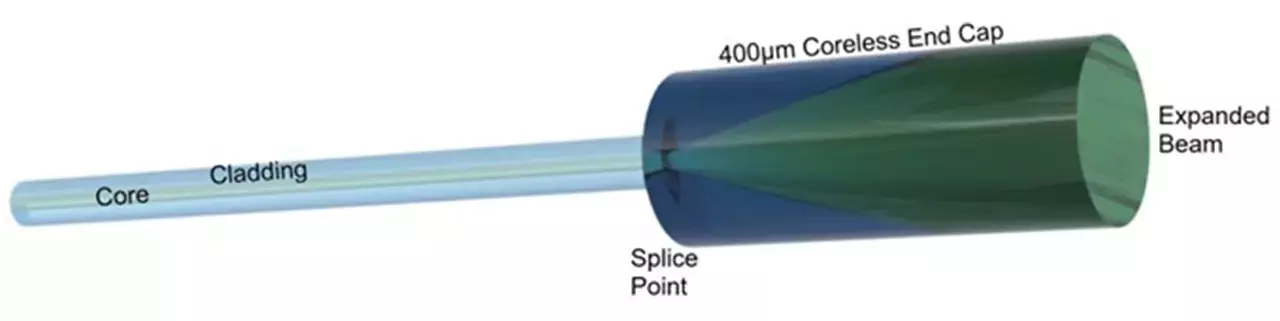
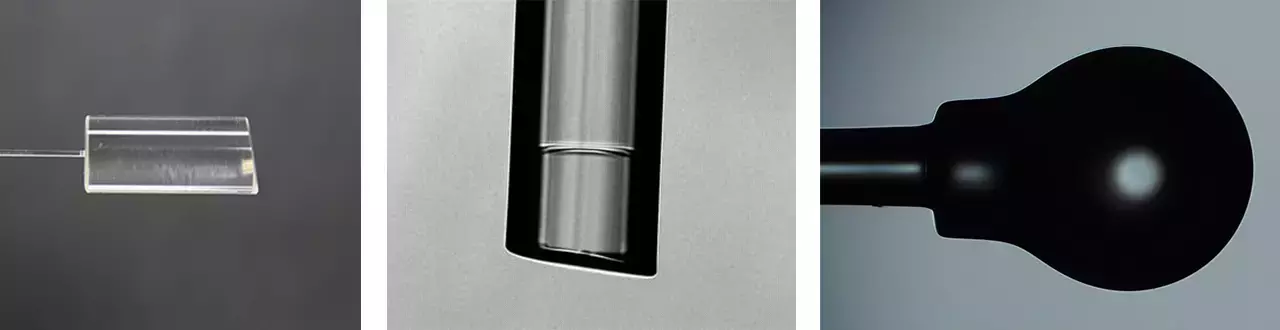
A fiber end cap is a short section (or sections) of optical glass, usually made of high-purity coreless or graded-index fused silica, that is permanently joined to the end of an optical fiber via fusion arc or laser. It acts as a protective and functional extension of the fiber, allowing light to expand before it exits into free space. The result is lower optical power density, reduced risk of surface damage, and better beam control.
Instead of terminating the fiber directly at the glass-air boundary, an end cap provides an intermediate section of homogeneous glass with no waveguide core. Light from the fiber core propagates through the cap, expanding naturally before reaching the output surface. This expansion reduces the intensity at the interface and protects both the fiber and the connected optics from excessive power density and back-reflections.
Why Fiber End Caps are essential
Fiber end caps serve several interrelated purposes: optical, mechanical, and environmental. Their benefits are particularly critical in high-power or high-precision systems where reliability and beam quality cannot be compromised.
Lowering Optical Power Density
When high optical power travels through a fiber, the output beam carries a tremendous energy density (J/cm2) at the small glass-air interface. This concentration of power can cause localized heating, melting, or even catastrophic damage to the surrounding optical package or connector. The fiber end cap acts as an optical buffer: by allowing the beam to expand inside the cap before exiting, the optical intensity at the final surface drops significantly. This simple yet effective concept dramatically increases the damage threshold of the termination and enables higher continuous-wave and pulsed power operation.
Minimizing Back-Reflections
At the point where light exits a fiber, a small portion of that light reflects back toward the source. In high-gain amplifiers, source lasers or precision sensing systems, these reflections can cause instability, reduce performance, or even damage upstream components. A properly designed end cap increases the optical path between the fiber core and the air interface, allowing the beam to expand and diverge slightly before it encounters the boundary. This minimizes back-reflection and stabilizes system operation.
Protecting Structured or Large-Core Fibers
Certain fiber types, such as photonic crystal fibers, hollow-core fibers, or large-mode-area fibers, have complex internal geometries that are difficult to terminate cleanly. Open microstructures at the fiber face are prone to contamination or moisture ingress. By sealing the fiber with a coreless glass end cap, the structure is protected from environmental damage and contamination, while maintaining excellent optical transmission.
Shaping and Controlling the Beam
Fiber end caps can also play an active role in beam conditioning. By adjusting the diameter, length, or angle of the end cap, engineers can influence the output beam’s divergence, waist location, and numerical aperture (NA). This makes end caps valuable not only for protection, but also as part of a broader optical design strategy, especially in laser delivery systems and fiber-coupled collimators
Optical fibers end-capped with large diameter coreless fiber is typically required for ball lenses. The increased volume of the coreless fiber serves as material for the formation of ball lenses larger than 200µm. Ball lenses are ideal for both collimation and high manipulation beam emission (waist, spot, focal length, etc.)
Graded-index (GRiN) multimode fibers are also often combined with segments of coreless fiber for NA manipulation and collimation. When laser cleaved to ¼ pitch, the GRiN structure acts as a collimator.
Enabling Higher Power Systems
As laser powers continue to scale upward, end caps are a key enabler for next-generation fiber laser systems. They make it possible to safely operate at higher powers without risking surface damage, and to integrate large-core or specialty fibers into high-energy applications. Without end caps, many modern fiber-laser designs would face severe reliability and thermal limitations.
The Role of Laser Processing in
Fiber End-Cap Manufacturing
Producing reliable, high-performance fiber end caps requires extraordinary precision. Every detail, from splice strength to surface flatness, affects optical efficiency and long-term durability. Laser processing is central to achieving the required precision and repeatability.
Laser Cleaving
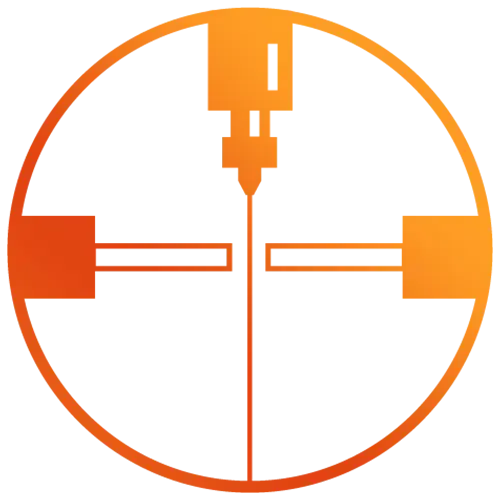
Traditional mechanical cleaving can introduce micro-cracks, debris, and angular inconsistencies. Laser cleaving, by contrast, produces smooth, defect-free end faces with precise control of angle and geometry. It also enables the processing of large-core or structured fibers that are difficult to handle mechanically. This ensures clean interfaces for subsequent fusion or splicing steps.
Laser Fusing and Splicing
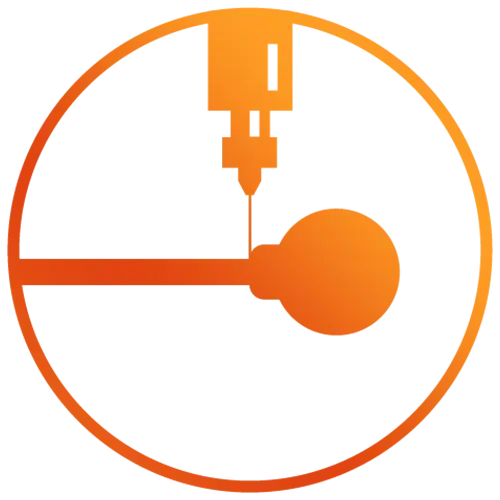
Joining the fiber to the end cap demands perfect alignment and temperature control. Laser fusing provides localized, programmable heating to join materials of different diameters or structures. This process produces a strong, low-loss bond between the fiber and the cap, minimizing insertion loss and improving long-term mechanical integrity. Laser fusing also allows engineers to join large-diameter caps for high-power beam expansion applications.
Laser Lensing
Some end caps incorporate curved or tapered surfaces to influence beam shape or focal length. Laser lensing enables the creation of these features directly in glass, eliminating the need for separate optics. This process delivers all-silica assemblies that are compact, robust, and optimized for specific beam characteristics.
Precision and Repeatability
Laser-based manufacturing offers micron-level precision, automation potential, and tight process control. Parameters such as cap protrusion, cleave angle, and fiber orientation can be controlled and repeated consistently across production batches. For industries that require high-volume or high-reliability optical components, this repeatability is essential.
Engineering Considerations When Designing with Fiber End Caps
Choosing or specifying fiber end caps involves several design and performance considerations:
Material Selection
End caps are typically made from high-purity fused silica or ultra-low-absorption optical glass. The material must handle high thermal loads and maintain low optical loss. Large diameter coreless fiber or graded-index fibers will also be required for certain applications.
End Cap Geometry
The diameter and length determine how much the beam expands before exiting. Larger end caps allow more expansion and lower output power density. Large diameter end caps are required for higher-volume applications such as ball lensing.
Surface Finish
The output face should have minimal surface roughness and can include anti-reflection coatings to reduce back-reflections.
Cleave Angle, Length and Orientation
Slightly angled end faces help prevent reflections back into the core, particularly for polarization-maintaining (PM) fibers where alignment is critical. Excessive deviation in angle control will lead to undesired beam skew. End cap length is a very critical parameter, often requiring tolerances in the microns.
Thermal and Mechanical Stability
The splice between the fiber and the cap must withstand temperature fluctuations, vibration, and long-term stress without degradation.
Environmental Sealing
For structured fibers, hermetic sealing prevents contamination and ensures reliability in harsh or humid environments.
Each of these parameters influences the optical performance and durability of the final assembly. This is why working with a specialist partner like OpTek Systems, who can precisely control every stage of the process, is essential.
Applications of Fiber End Caps
Fiber end caps appear across a broad range of advanced optical systems, including:
High-Power Fiber Lasers and Amplifiers
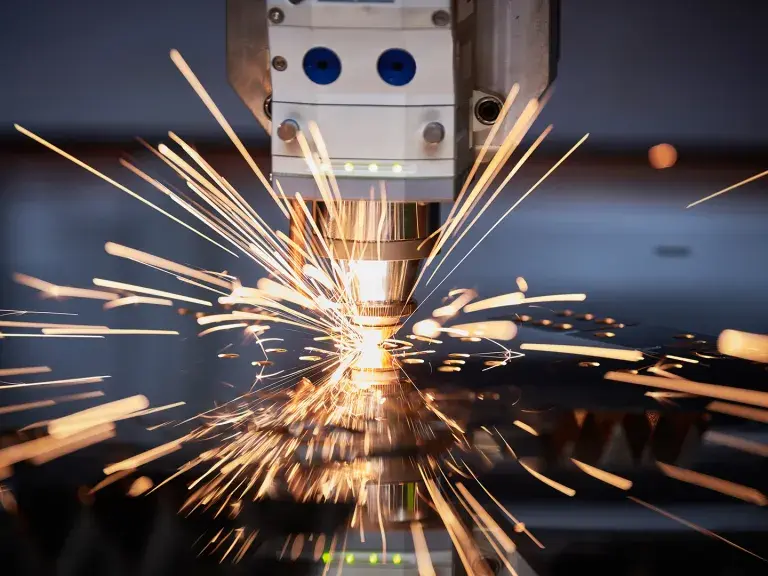
End caps are indispensable in industrial and scientific lasers where power densities can exceed the damage threshold of bare fiber ends. By expanding the beam and reducing local intensity, they allow laser systems to operate safely at higher powers.
Beam Delivery and Collimation Systems
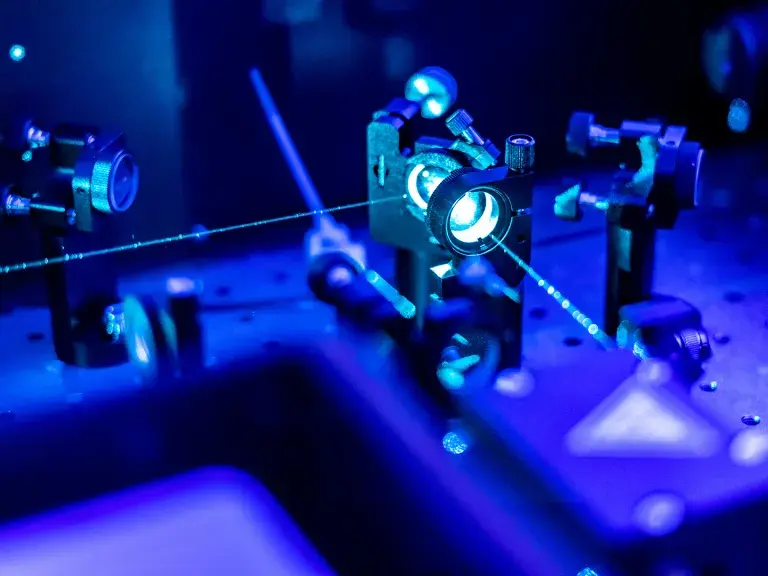
End caps are integrated into collimator assemblies and free-space delivery systems to shape and stabilize laser beams, improving coupling efficiency and beam quality.
Photonic Crystal and Hollow-Core Fibers
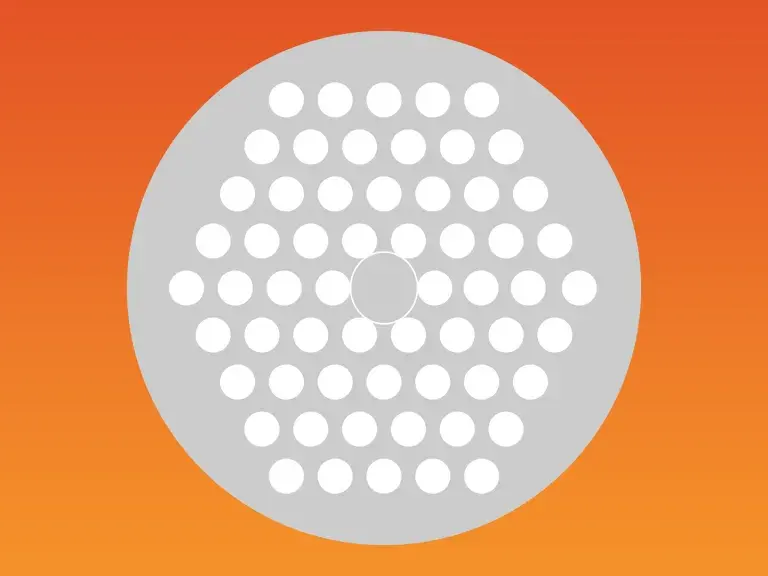
In these structured fibers, end caps seal the internal air holes and prevent contamination while maintaining optical performance.
Aerospace, Defense, and Sensing
In harsh environments, fiber end caps protect optical interfaces against dust, moisture, and mechanical stress, ensuring consistent performance over time.
Medical and Industrial Applications
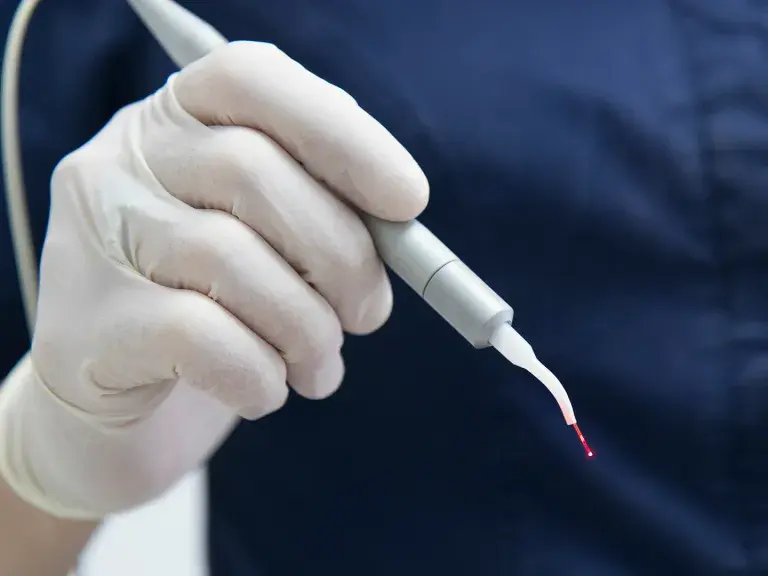
In surgical lasers, precision measurement tools, and material-processing systems, end caps enhance durability, reduce maintenance, and maintain optical clarity under challenging conditions.
OpTek Systems Your Partner for Precision Fiber End Caps
At OpTek Systems, we specialize in the development and manufacture of high-performance fiber end caps and related optical components. Our deep expertise in laser processing, optical design, and automated manufacturing allows us to deliver end-cap solutions that meet the highest industry standards.
Advanced Laser-Processing Capabilities
OpTek’s proprietary laser-cleaving and laser-fusing technologies enable precise, contamination-free processing of fibers and end caps. We handle standard, large-core, and structured fibers with equal precision. Our processes eliminate mechanical chipping and ensure consistent geometry, angle, and protrusion control. For polarization-maintaining fibers, we maintain strict orientation alignment to preserve optical integrity.
Tailored Solutions for High-Performance Applications
Every application has unique optical and mechanical requirements. OpTek designs end caps that optimize beam expansion, reduce reflection, and enhance power handling. Whether you require small-diameter caps for sensing or large-diameter fused assemblies for kilowatt-class lasers, our engineers can tailor the design to your exact specifications.
End-to-End Process Control
Our integrated approach combines optical design, laser processing, metrology, and quality assurance. Each end-cap assembly undergoes precise inspection for splice quality, angle, and surface finish. Automated systems ensure consistency across high-volume production while maintaining the tight tolerances required by advanced optical systems.
Global Manufacturing and Support
With facilities in the United Kingdom, the United States, and China, OpTek provides global coverage and flexible manufacturing options. Whether you need rapid prototyping, low-volume custom assemblies, or large-scale production, we have the infrastructure to support your needs.
Seamless Integration with Optical Systems
Our engineers work closely with customers to ensure the end cap integrates seamlessly into their optical assemblies. This includes controlling parameters such as numerical aperture, mode-field diameter, and beam waist location. We treat the end cap as part of the system, not an isolated component, so that it contributes directly to optical performance and reliability.
Why Engineers Choose OpTek Systems
Proven Track Record in Laser-Based Fiber Processing
OpTek has pioneered laser processing of optical fibers for over two decades. Our technologies are trusted by leading companies in defense, aerospace, medical, telecommunications, and industrial laser sectors.
Expertise Across Fiber Types
We process single-mode, multimode, polarization-maintaining, photonic crystal, and large-mode-area fibers. Our proprietary techniques ensure strong, low-loss splices and consistent end-face geometry across all fiber classes.

Engineering Collaboration
We partner with customers from concept through production. By understanding your optical design goals, we can optimize end-cap geometry, laser parameters, and metrology processes to ensure your system performs as intended.
Scalable Manufacturing
OpTek’s combination of precision automation and flexible production allows smooth transition from prototype to volume manufacturing. Our systems maintain repeatability and traceability for every unit, ensuring confidence in long-term performance.

Quality and Reliability
All OpTek end-cap assemblies are manufactured to rigorous quality standards, with attention to cleanliness, optical alignment, and mechanical integrity. Every process is validated to ensure minimal insertion loss, low back-reflection, and maximum damage threshold.
Fiber end caps may be small, but their impact on optical system performance is significant. They protect high-value fiber assemblies, enhance beam quality, and enable the safe transmission of high optical power. As power levels and system complexities continue to rise, the precision and reliability of the end-cap manufacturing process become even more critical.
OpTek Systems stands as a global leader in laser-based fiber processing, offering unmatched expertise in the design and manufacture of fiber end caps. Through advanced laser cleaving, fusing, and lensing, combined with meticulous process control and engineering support, we deliver solutions that enable our customers’ technologies to perform at their highest potential.
For organizations developing the next generation of laser, sensing, or communication systems, OpTek Systems is the trusted partner for every fiber end-capping need, where precision, reliability, and performance come together.