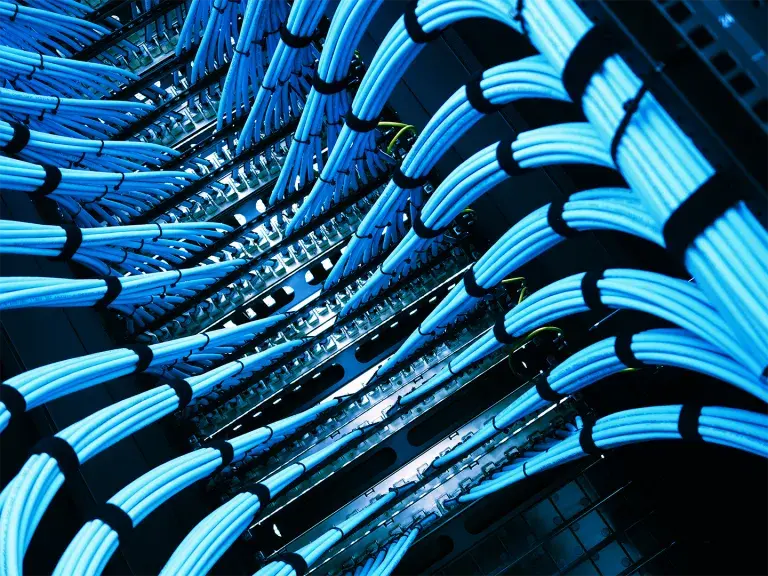
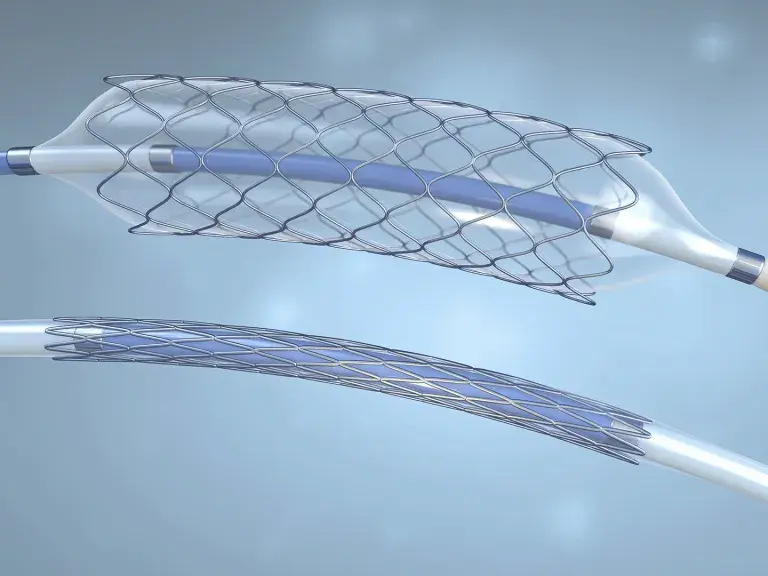
Technical ceramics provide an unusual combination of hardness, electrical insulation, wear resistance, chemical stability and high-temperature performance. Those properties make materials such as alumina, aluminum nitride, zirconia, silicon nitride, silicon carbide and ferrite valuable in electronics, medical technology, aerospace, energy and other demanding industries. They also make finished ceramic components difficult to machine.
Laser processing provides a non-contact, digitally controlled route for producing features in technical ceramics without a cutting tool applying mechanical force to the workpiece. Depending on the material and component requirements, a laser process can be developed for cutting, scribing, drilling, marking, surface structuring, micro milling or selective removal of a metallized layer.
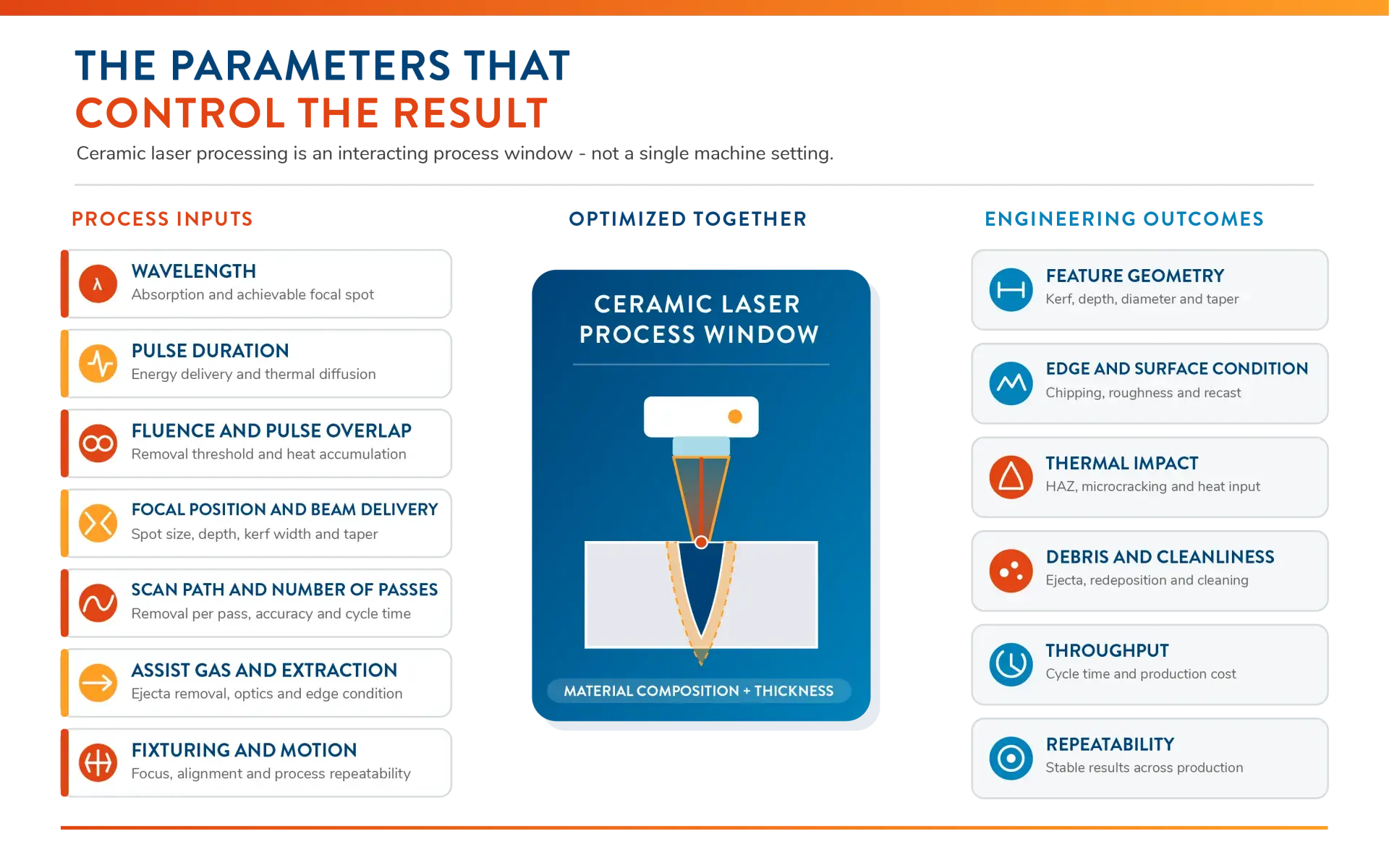
The word "laser," however, does not define a process. Wavelength, pulse duration, pulse energy, beam quality, focal geometry, scan strategy, gas assist and part handling all influence the result. For ceramic components, the central engineering task is to achieve the required geometry and throughput while controlling heat input, debris, taper, chipping and crack risk.
Why are technical ceramics challenging to machine?
Ceramics are chosen because they perform where many conventional materials cannot. Alumina, for example, is widely used for its electrical insulation, mechanical strength, corrosion resistance and wear resistance. Yet the high hardness and relatively low fracture toughness associated with many technical ceramics can complicate machining after sintering.
Mechanical machining may require diamond tooling and carefully controlled feeds, speeds and coolant conditions. Tool wear can alter feature geometry over time, while contact forces can contribute to edge chipping or subsurface damage. Tooling can also restrict how quickly a manufacturer can change a hole pattern, cut path or feature design.
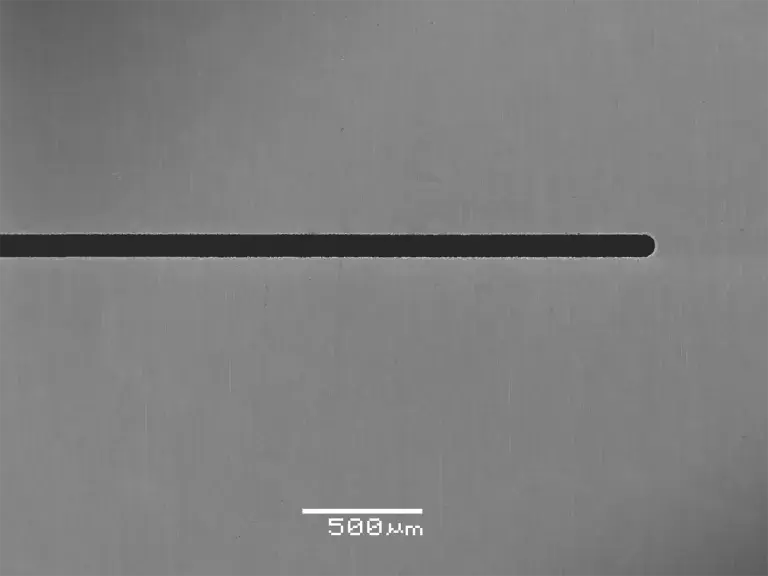
Laser processing removes the cutting tool from the equation. A focused beam delivers energy only where it is required, and CNC or scanner motion defines the feature from digital data. This can enable narrow kerfs, small holes, complex contours and rapid design changes without hard tooling. The absence of tool contact also eliminates tool breakage and avoids progressive tool wear as a direct source of dimensional drift.
How Laser material interaction changes the result
Laser machining begins with absorption. The workpiece must absorb enough optical energy at the selected wavelength and intensity for material removal or modification to occur. Because different ceramic compositions, binders, additives, surface finishes and coatings absorb differently, a laser that performs well on one grade of alumina may not produce the same result on another ceramic.
Pulse duration then influences how energy is delivered. Longer interaction times can increase thermal diffusion into the surrounding material. Short and ultrashort pulses concentrate energy into much shorter time periods, which can reduce heat input and melt formation when the process is correctly configured. Ultrafast processing is therefore valuable for precision features and heat-sensitive structures, although the highest-quality route is not automatically the highest-throughput or lowest-cost route.
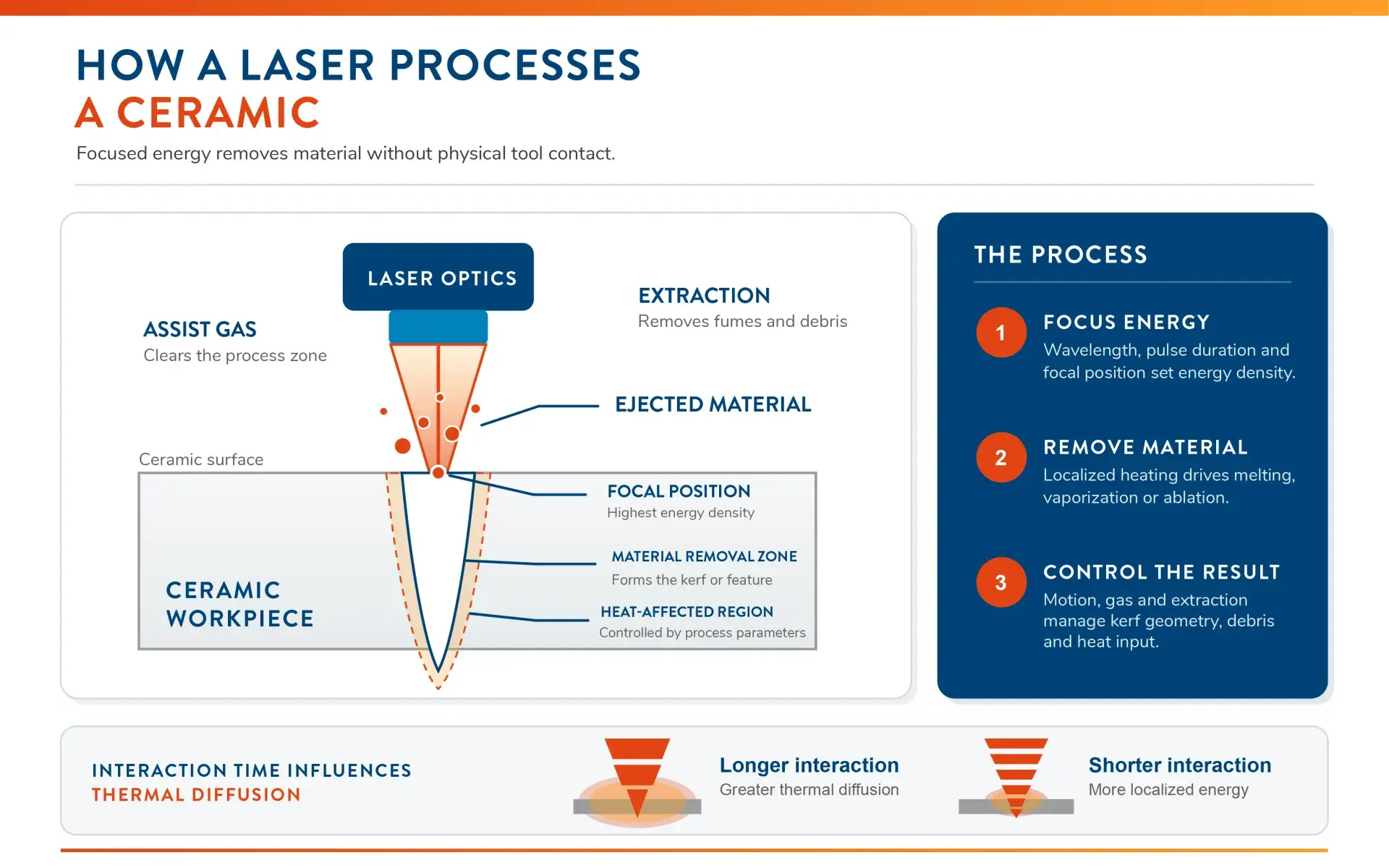
For industrial production, the optimum process balances more than edge appearance. It must also account for cycle time, part cost, acceptable feature variation, cleaning requirements, system availability and process stability over the intended production volume.
The Parameters that matter
| Process Variable | Why it Matters |
|---|---|
| Wavelength | Controls how strongly the ceramic, binder or coating absorbs the beam and affects the achievable focal spot. |
| Pulse duration | Influences the balance between localized ablation and thermal diffusion into the surrounding material. |
| Fluence and pulse overlap | Determine whether energy is sufficient for efficient removal without excessive heating or debris. |
| Focal position and beam delivery | Affect kerf width, taper, feature depth, consistency and sensitivity to part-height variation. |
| Scan path and number of passes | Control material removal per pass, heat accumulation, contour accuracy and processing time. |
| Assist gas and extraction | Help remove ejecta and fumes, protect optics and influence the condition of the processed edge. |
| Fixturing and motion | Maintain focus, alignment and repeatability while protecting brittle parts from handling stress. |
| Inspection strategy | Confirms that geometry and material condition meet the functional acceptance criteria. |
Laser Processing Applications For Ceramic Components
Laser Cutting
Laser cutting can create straight cuts, apertures and complex external profiles from CAD data. It is particularly useful where mechanical contact, tool wear or the cost of dedicated tooling is undesirable. The required edge condition will determine whether the process prioritizes speed, minimal thermal impact, narrow kerf, low taper or reduced post-processing.
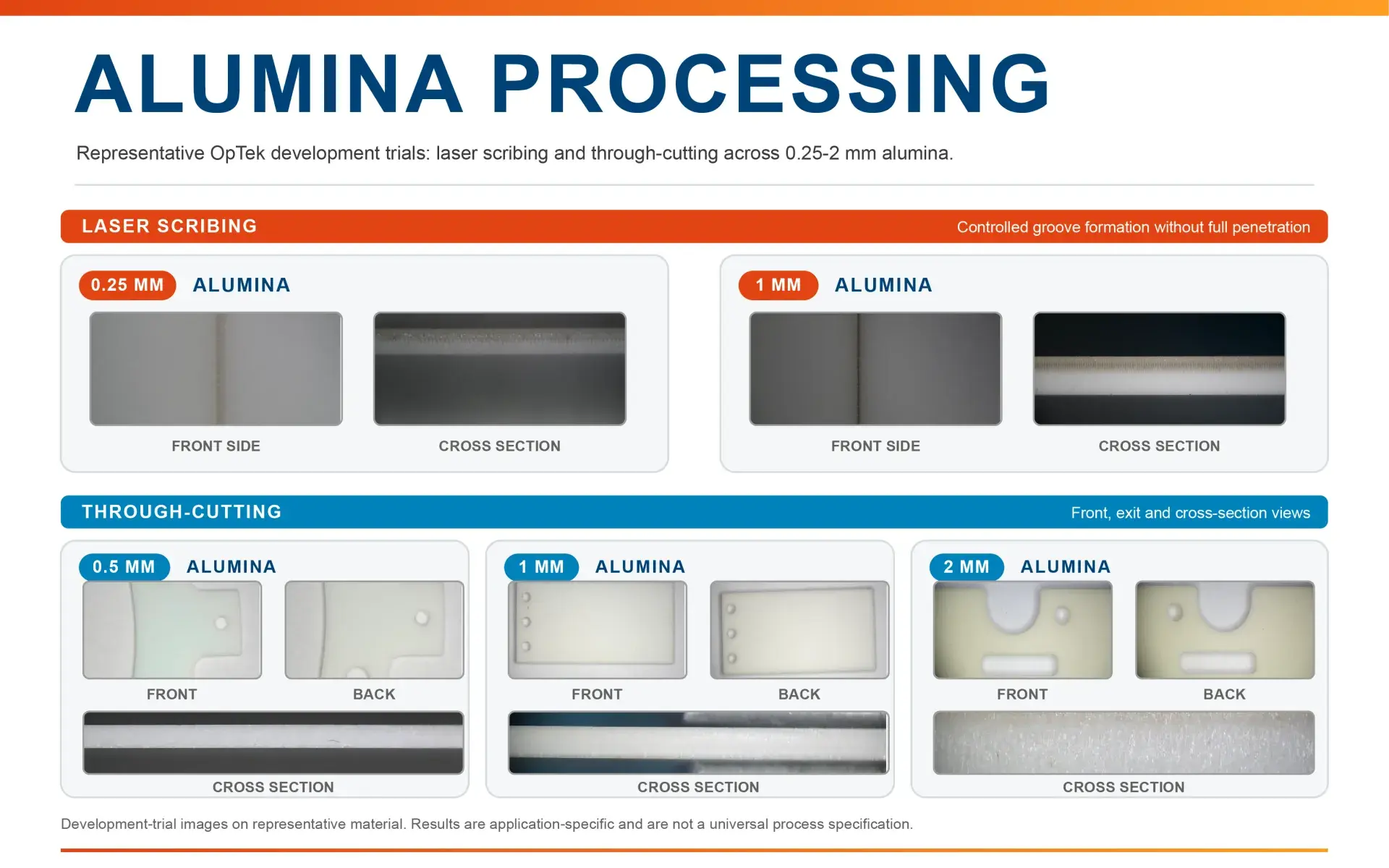
In OpTek development trials, a quasi-continuous-wave laser process was used to evaluate both scribing and through-cutting of alumina samples. The work included scribing 0.25 mm and 1 mm alumina and cutting 0.5 mm, 1 mm and 2 mm alumina. Separate parameter sets were developed for each thickness, illustrating why ceramic laser cutting should be engineered around the actual material, thickness and acceptance criteria rather than a generic recipe.
Laser Scribing
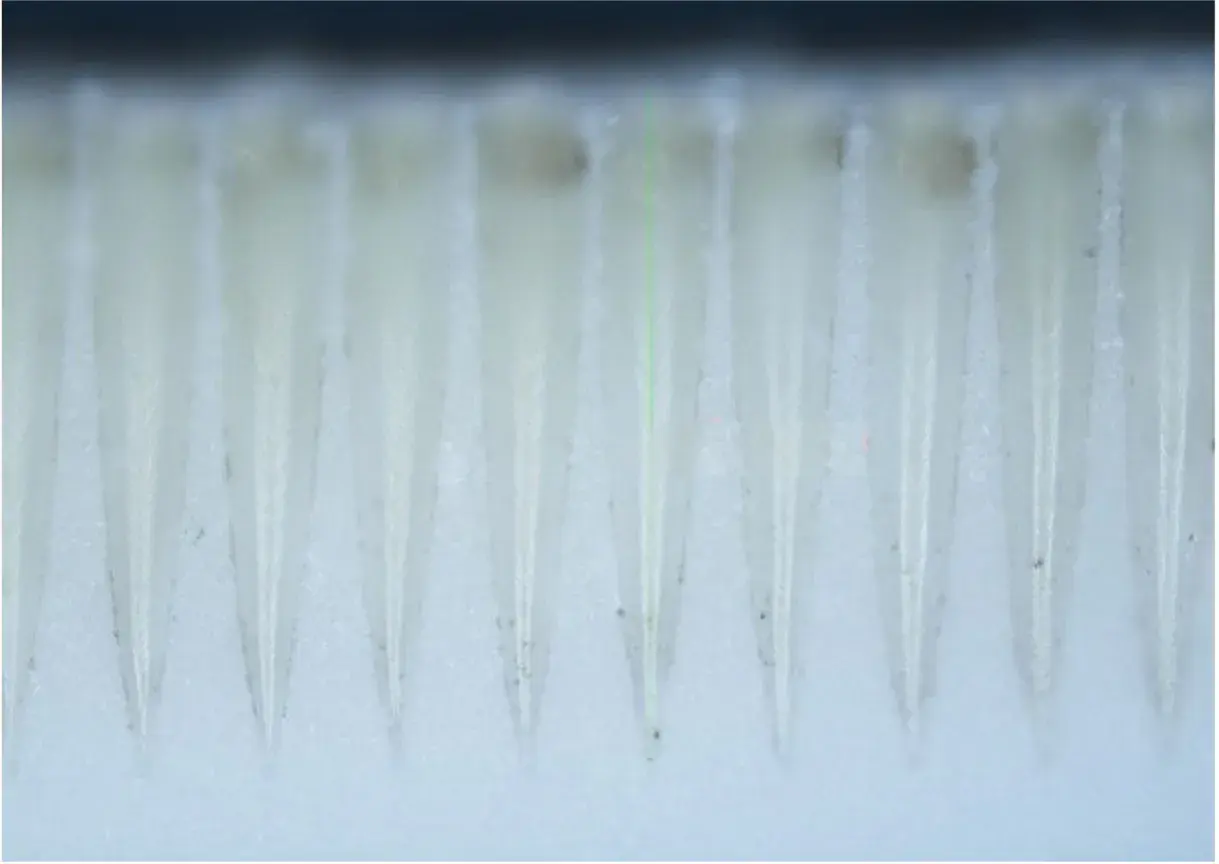
Laser scribing is a technique used to facilitate the easy singulation of ceramic substrates and circuits from a panel or sheet. Unlike laser cutting, the laser beam does not penetrate completely through the material during the scribing process. Instead, the objective is to create a perforated line along which the substrate can be cleanly and easily separated.
In essence, a series of small blind holes are drilled in close succession along a straight line, creating a controlled weak point in the material. No spacing needs to be incorporated between adjacent designs, as the scribe lines do not affect the final dimensions of the part. The depth of the blind holes is typically less than half the thickness of the substrate.
Laser Drilling
Laser drilling is suited to small holes, repeated hole arrays and geometries that would create significant tool-wear or breakage risk for a mechanical drill. Percussion drilling, trepanning and helical strategies provide different combinations of speed, diameter control, taper and surface condition. The appropriate method depends on hole diameter, depth, aspect ratio, quantity and whether the hole is functional, fluidic, optical or electrical.
Surface Texturing, Marking & Micro-Milling
A laser can remove or modify material without cutting through the component. Applications include functional texturing, identification marks, microchannels, shallow pockets and localized surface modification. Where the feature changes friction, wetting, bonding or electrical behavior, verification should measure the functional property as well as the visible geometry.
Selective Layer Removal
Many ceramic components form part of a multilayer structure or carry a metallized surface. A short-pulsed laser can be developed to remove a coating or conductive layer selectively while limiting the effect on the ceramic substrate and adjacent features. This requires control of removal depth, layer uniformity, edge definition and substrate exposure. It is a process-integration problem, not simply a marking operation.
Choosing the right process for a ceramic
There is no single best laser for all ceramics. Selection begins with the material and the function of the finished feature. Engineers should define the ceramic grade and composition, sintered density, thickness, surface finish, coatings, required geometry and allowable damage before selecting the laser architecture.
Quality criteria may include:
- Dimensional accuracy and repeatability
- Kerf or groove width
- Cut-wall taper and edge profile
- Entry and exit condition
- Chipping, microcracking and heat-affected material
- Recast, debris and cleaning requirements
- Hole roundness, cylindricity or aspect ratio
- Surface roughness or texture parameters
- Electrical, mechanical, fluidic or bonding performance after processing
Acceptance criteria should be tied to component function. A cosmetic inspection may be sufficient for a permanent identification mark, but a ceramic substrate for an electronic assembly may also require electrical testing, adhesion checks or thermal-cycling validation. Likewise, a fluidic or medical component may demand tighter control of debris and internal feature condition.
Why work with OpTek Systems?
OpTek Systems develops precision laser processes and translates them into reliable manufacturing solutions. Its engineering capability brings together lasers, optics, laser-material interaction, automation, vision, motion control and software. Customers can engage OpTek for process development, subcontract laser machining, turnkey production equipment or integration into an existing line.
For ceramic applications, this combined capability matters. Feature quality depends on the interaction between the laser process, part presentation, handling, extraction, inspection and production controls. Addressing those elements together helps move a technically feasible result toward a stable, maintainable manufacturing process.
Frequently Asked Questions
Can Ceramic be laser cut?
Yes. Many technical ceramics can be laser cut, although the appropriate wavelength, pulse regime, beam delivery and scan strategy depend on the ceramic composition, thickness and required edge quality. Trials on representative material are recommended.
Which ceramic can be laser processed?
Potential candidates include alumina, aluminum nitride, zirconia, silicon nitride, silicon carbide and ferrites, as well as coated or metallized ceramic substrates. Feasibility and quality depend on the specific grade, additives, thickness and surface condition.
Does laser cutting crack ceramic material?
A poorly controlled process can create thermal stress, chipping or microcracking. Risk is managed through laser selection, pulse duration, fluence, scan strategy, heat control, fixturing and inspection. The acceptable result must be defined for the component's end use.
What is the best laser for cutting alumina?
There is no universal answer. Infrared, green, ultraviolet and ultrashort-pulse sources can each be appropriate in different circumstances. Selection should balance absorption, feature size, material thickness, thermal sensitivity, throughput and cost.
Can a laser remove metal from a ceramic substrate?
Yes, selective laser ablation can be developed to remove metallization or a thin film from a ceramic. The process must control layer removal, edge definition and the degree of interaction with the substrate.
SHOULD WE SUBCONTRACT CERAMIC LASER PROCESSING OR BUY A MACHINE?
Subcontract processing can reduce risk for development, qualification and variable demand. A dedicated machine may be preferable when volume, line integration, process ownership or supply-chain considerations support in-house production. OpTek offers both routes.