Introduction
Filters are used across a wide range of industries, and many applications can be served by simple fibrous media such as paper or plastic-fiber mesh. For more demanding applications, however, variation in the size of particles that pass through the filter, or contamination from the filter material itself, may be unacceptable. In these cases, pore size must be tightly controlled across millions of individual locations. This can be achieved by drilling precise holes in a solid, inert material.
Typical feature sizes range from 1 micrometer to 1 millimeter. Lasers are particularly effective at the smaller end of this range, especially for materials that are difficult to machine mechanically, including thin foils, glass, and polymers.
To meet the growing demand for high-precision filtration, OpTek Systems has developed a suite of laser processes capable of delivering micrometer-level accuracy across a wide range of applications at production-ready processing rates.
Unlike fibrous media, a laser-drilled membrane can be engineered around a defined pore diameter, pitch, pattern, and open area. This gives designers greater control over filtration behavior and flow, while the use of a solid, inert substrate can reduce concerns around fiber shedding or contamination. Because laser drilling is a non-contact process, there is no cutting tool to wear, break, or introduce mechanical forces into delicate material.
Problem: Challenges of Machining Micro-Hole Arrays
The main challenges when machining precision hole arrays are:
- Consistent pore geometry - pore size, shape, and spacing must be tightly controlled to ensure predictable filtration performance.
- Maximum open area without compromising mechanical strength - the pores must be packed closely enough to achieve the required flow rate, while the membrane must still withstand pressure and handling forces without tearing, cracking, or deforming.
- Manufacturability at scale - the process must be repeatable, efficient, and capable of maintaining tight tolerances at production volumes.
These requirements are closely linked. Reducing the pore pitch may increase open area and flow, but it also leaves less material between adjacent holes. Membrane thickness, pore taper, entrance and exit quality, and local heat input can all influence strength and performance. When an array contains millions of features, even a small shift in process stability can become significant, making process control and repeatable inspection essential.
Solution: Bespoke Laser Processing
OpTek Systems addresses these challenges on an application-by-application basis. In many cases, ultrashort-pulse lasers operating at wavelengths such as 315 nm, 515 nm, and 1064 nm, and delivering femtosecond pulses, provide the best solution. These lasers can produce holes with very tight tolerances and minimal heat-affected zones. This allows pores to be positioned very close together while preserving a strong membrane that can withstand high pressures.
Laser selection is only one part of process development. Wavelength determines how efficiently the material absorbs laser energy, while pulse duration, spot size, fluence, and repetition rate influence feature geometry, heat input, and cycle time. OpTek evaluates these parameters alongside material thickness, required pore diameter and tolerance, acceptable taper, array density, and edge-quality requirements to establish a robust process window.
For more cost-sensitive applications, however, the slower machining rates and higher initial purchasing costs of femtosecond laser processing may be prohibitive. In these cases, the process can be optimized around a fiber laser delivering nanosecond pulses. Although this typically produces a larger heat-affected zone, it can machine thicker materials significantly faster than a femtosecond laser.
Both approaches can be combined with conventional CNC stages, galvanometer-based beam steering, or beam-splitting techniques to achieve the required process speed.
The result is high-speed, high-precision micromachining tailored to the material, application, and production requirements.
This development work can be completed through OpTek's subcontract laser processing service. Initial feasibility trials assess material response and produce representative samples, followed by parameter optimization, inspection, and scale-up. Customers can use the service for prototypes, pilot quantities, or repeat production without immediately investing in specialist equipment. Where requirements later justify an in-house process, the developed method can also provide the basis for dedicated production equipment.
Case Study: Technology in Action
Circulating Tumor Cell (CTC) Isolation
Specialized microfilters can be used to enrich circulating tumor cells (CTCs) from blood samples for subsequent analysis. This approach uses differences in cell size and deformability: healthy blood cells can deform and pass through small pores, while larger or less deformable tumor cells are retained. By carefully controlling the pore geometry, the filter can capture cells for further analysis.
This application involved drilling 6 micrometer holes in 25 micrometer-thick PET sheet with a diameter accuracy of +/-0.5 micrometer. Using either a femtosecond or nanosecond laser, each hole could be drilled with a single pulse. In this example, the achieved drilling rate was 30,000 holes per second.
For an array of this scale, pore-to-pore consistency is critical. Variations in diameter or spacing can alter flow through the filter and affect how cells interact with the membrane. The PET sheet is also thin and thermally sensitive, so the process must deliver the required geometry while limiting heat accumulation and distortion.
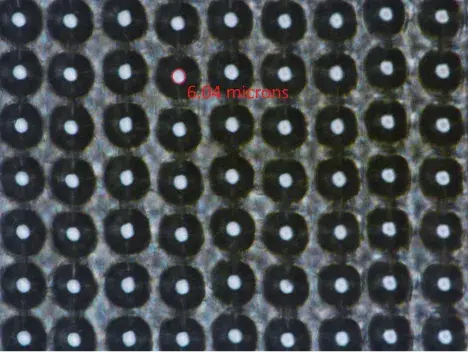
Figure 1: Typical CTC filter with arrays containing up to 250 million holes.
HIGH-POROSITY DRILLING FOR ENERGY APPLICATIONS
In this application, the laser was used to drill high-density hole arrays in supporting structures for next-generation fuel cells and batteries.
The product design allows fragile chemical slurries to be supported by a membrane while enabling gases to pass through the barrier.

Figure 2: Array of 40 micrometer holes in 0.25 mm steel sheet.
The drilling process needed to be fast enough to meet cost targets while minimizing heat input to avoid distortion of the filter material. In this case, a longer-pulse nanosecond laser was used to increase throughput, and a carefully designed drilling pattern limited heat accumulation. This approach enabled drilling rates exceeding 1,000 holes per second.
The drilling sequence was as important as the laser parameters. Distributing the holes across the sheet, rather than processing adjacent features continuously, allowed heat to dissipate between pulses. This helped maintain sheet flatness and pore quality while achieving the production rate required for a commercially practical component.
Conclusion
OpTek Systems has developed processes to drill holes as small as 1 micrometer in a wide range of materials, including plastics, metals, glass, and ceramics.
By selecting the right laser for the application, OpTek can optimize the process for tightly toleranced pore geometry, maximum throughput, or the most effective balance between the two for the customer's production environment.
By using OpTek's subcontract processing capability, customers can evaluate new membrane designs, compare materials, and establish realistic production costs before committing to a manufacturing route. The same development pathway can then support the transition from early samples to repeatable volume production.